

By Robert Pharréll
A professional dance school uniform is a managed system covering students, teachers and staff, teams, branding, sizing, ordering and consistency, not simply a collection of garments. For an overview of our services, explore dance school uniforms from The Printwear Company.
A structured approach helps you define what people wear, when they wear it, how garments are ordered and how the system can support future growth. This guide explains the main parts of a dance school uniform system and the decisions organisations should make before selecting garments or a supplier.
A dance school uniform is an approved set of clothing and related apparel used by students, teachers, staff or representatives of a dance school or performing arts academy for training, teaching, performance, competition, events or public-facing activity.
A uniform may include dancewear, warm-up clothing, footwear guidance, staff clothing, teamwear, competition apparel and optional merchandise. The exact range depends on the organisation’s programmes, age groups, teaching requirements, identity and operating model.
A uniform system is the framework used to define, brand, order, size, produce and fulfil an organisation’s approved apparel. It connects garment selection and visual identity with ordering structures, production standards and ongoing management.
Within our structured framework for dance schools and performing arts academies, uniform is organised into four categories:
| Category | Who it is for | When it is used |
|---|---|---|
| Student Uniform | Students and dancers | Classes, training, rehearsals and specified academy activity |
| Teacher and Staff Uniform | Teachers, assistants, administrators and operational staff | Teaching, administration, events and public-facing activity |
| Teamwear and Competition Apparel | Competition teams, troupes and representatives | Competitions, conventions, performances and team activity |
| Supporter Merchandise and Fanwear | Parents, families, alumni, supporters and wider communities | Informal wear, events and public support |
A student uniform is the approved clothing worn by dancers for classes, training, rehearsals or academy activity. It may be organised by age, level, genre, programme or examining requirement.
Depending on the organisation, the range may include leotards, tops, leggings, shorts, trousers, skirts, warm-up layers, hoodies, jackets and appropriate footwear guidance. It should support movement and teaching requirements while providing a clear and consistent standard.
The range should also be considered in relation to comfort, fit and inclusion. One Dance UK’s Industry Standards state that dancers have a right to safe and appropriate working environments that support physical and psychological health.
A staff uniform is clothing approved for teachers, assistants, administrators and other team members who represent the organisation. It may distinguish staff from students while remaining part of the same visual identity.
Staff clothing can include polos, T-shirts, sweatshirts, jackets, trousers or performance-appropriate layers. The right range depends on whether staff teach, work front of house, attend competitions, manage events or represent the school externally.
Teamwear is coordinated clothing used by a defined team, troupe or representative group to identify its members and support a shared appearance.
Competition apparel is clothing created for competition, championship, convention or performance activity. It may have different design, decoration or garment requirements from everyday student uniform because it needs to function in a public, photographic or performance setting.
Teamwear should remain connected to the wider organisation. It can create distinction without becoming visually disconnected from the school’s core identity.
Supporter merchandise is optional branded clothing or products that people choose to buy and wear in support of an organisation.
Fanwear is informal apparel worn by parents, families, alumni, friends and supporters rather than as a compulsory uniform. It may include T-shirts, hoodies, sweatshirts, caps, bags or other branded items.
Supporter merchandise should be managed differently from compulsory student uniform. It can be more expressive, seasonal or event-led, but it should still follow approved brand standards.
A small school may manage clothing through informal decisions. One person orders a hoodie. Another chooses a competition top. Parents source individual garments from different suppliers. This can work temporarily, but it becomes more difficult to control as the organisation grows.
Structure provides:
Consistency is not the same as making every garment identical. A well-structured system allows appropriate variation while defining where that variation belongs.
A ballet class, competition team and teaching staff may need different garments. They should not look unrelated.
A complete uniform system connects five operational areas. Our school uniform management system explains how these functions work together.
The approved garment range defines which products are available, who they are for and what role each item performs.
A range may be divided into core uniform, programme-specific clothing, warm-up layers, staff apparel, teamwear and optional merchandise. Each item should have a reason to exist.
The range should also consider garment suitability. Dance clothing needs to support movement, repeated washing, appropriate coverage, comfort and the practical conditions in which it will be worn.
Branding establishes how the organisation’s identity appears across garments. This includes logo application, colour, typography, garment selection, decoration position and the relationship between core uniform and optional merchandise.
Brandworx® is The Printwear Company’s uniform and apparel branding and design system for performing arts organisations. Brandworx® defines what an organisation wears, who wears it and how its identity is applied, creating one coherent system from identity through to production.
Brand decisions should be made before production begins. A logo that works on a website may require adjustment for embroidery, screen printing, transfer application or small-scale use.
For further context, see dance school branding and belonging and dance branding defined.
Ordering structures determine how garments move from an approved range to the people who need them.
Some organisations order centrally and distribute garments themselves. Others allow parents and students to order directly through a controlled portal. Some use different approaches for compulsory uniform, teamwear and event merchandise.
Open-ended ordering can create uncertainty around production and delivery. Defined ordering windows allow organisations to plan demand, communicate deadlines and align production with operational requirements.
Dance school uniform sizing should be planned around the actual users of the garments. Children, teenagers, adult students, teachers and staff may require different size ranges and garment cuts.
Dance uniform sizing needs a more considered approach than simply selecting standard apparel sizes. Accuracy matters operationally. It affects wearer comfort, movement, confidence, ordering clarity, exchange volume and production reliability.
Sizing should therefore be connected to the wider uniform system rather than treated as an isolated task. The organisation needs a clear approach to how sizes are identified, how guidance is communicated and how sizing information supports ordering and repeat production.
Uniform design should also consider dancer wellbeing. Lydia Frew’s The Hidden Curriculum in Dance: Investigating the Relationship Between Perceived Social Psychological Climate and Dancers’ Body Image (Bates College honours thesis, 2025) examines dance environments and body image. Its findings are nuanced: individual factors, including body surveillance, were stronger predictors of body-image perceptions than the perceived learning climate. A separate peer-reviewed study, Problem Structure Perceived: Dance Practicewear Needs of Adult Female Dance Students (Mitchka, Black, Heitmeyer and Cloud, Clothing and Textiles Research Journal, 2009), identifies garment fit, comfort, selection and style as important dance practicewear considerations.
These findings do not mean that one garment is suitable for every class. They show why organisations should assess comfort, function and student agency alongside visual consistency. One Dance UK also provides support for eating disorders and body image.
Production covers garment sourcing, sampling, decoration, quality control, fulfilment and delivery.
Printworx® is The Printwear Company’s sourcing, decoration, production and fulfilment infrastructure. Printworx® manages apparel from sourcing and sampling through to decoration and fulfilment, with attention to garment suitability, production consistency and repeatable delivery.
Decoration should be selected according to the garment, design, stretch, wash requirements and intended use. Embroidery, screen printing, transfers and other methods each have different applications.
Garment care should also be communicated clearly. Dance Teacher’s costume-care guidance recommends washing frequently used leotards and tights after each wearing and adapting cleaning methods to the fabric. As general care advice, always follow each garment’s care label; suitable methods may include gentle washing and air drying, depending on the fabric.
The range should be designed around the organisation, not around a catalogue of available products.
A uniform range should reflect how your school operates. It should align with programmes, teaching requirements, age groups, teams, staff roles and public-facing activity. The objective is not to offer more items. It is to define the right items and make their purpose clear.
There is no universal number of items that every dance school uniform should contain. The right range depends on the structure of the organisation and the practical role each garment plays.
Each item should support a clear requirement. That may be a teaching need, a programme distinction, a staff function, a team requirement or a practical layer for travel and warm-up. If an item does not support the way the organisation operates, it should not automatically be included because it appears in a supplier catalogue.
A clear range should distinguish between:
This distinction makes communication easier for families and reduces uncertainty around what must be purchased. It also helps the organisation define the difference between core uniform, additional choice and event-led apparel. Event merchandise sits alongside the uniform system. It is not a fifth uniform category.
The two main models are school ordering and parent ordering. The right choice depends on the organisation’s capacity, control requirements and preferred distribution process.
| Area | School ordering | Parent ordering |
|---|---|---|
| Control | The school manages the order and approved distribution | The school defines the range while families place individual orders |
| Workload | Greater internal responsibility for collection, checking and distribution | Less routine administration when payment, production and fulfilment are managed externally |
| Distribution | Garments are consolidated and distributed by the organisation | Garments are fulfilled to the individual ordering group or agreed delivery process |
| Administration | Requires internal order records and payment management | Requires clear ordering windows, product information and communication |
| Best suited to | Organisations that want direct control over resale and distribution | Organisations seeking a managed service with reduced internal handling |
With school ordering, the organisation collects requirements, places a consolidated order and manages distribution. This can provide direct control over pricing, stock and communication.
It may suit schools with sufficient administrative capacity, predictable demand and a clear internal distribution process. It also allows an organisation to manage resale and parent communication directly.
With parent ordering, families order directly during defined windows. The organisation controls the approved range while the production and fulfilment process is managed through the apparel system.
Within the Uniform Hub® model, parent ordering supports direct ordering during seasonal or collection windows. The Printwear Company manages payment, production and fulfilment. Any commercial arrangements for parent ordering, including pricing and fulfilment terms, are agreed with the organisation before launch.
Choose the model that matches your resources rather than assuming that one model is universally better.
School ordering may provide greater control but requires more internal administration. Parent ordering may reduce routine workload but requires clear product information, deadlines, sizing support and communication.
A uniform communicates identity through repeated use. Students wear it in classes. Teams wear it at competitions. Teachers wear it when representing the organisation. Families may wear supporter merchandise outside the studio.
That makes consistency an operational issue, not simply a design preference.
A school should define:
A structured identity can strengthen recognition and belonging, but it should not ignore comfort or the needs of different wearers. The aim is a coherent system with appropriate choices.
The professional performing arts uniforms principle explores the relationship between uniform, identity and belonging. The Images Magazine feature provides verified external coverage of The Printwear Company’s approach to dance school brand identity.
Teamwear and competition apparel require their own planning because they are linked to specific groups, events and delivery dates.
Consider:
A competition range may include tops, jackets, trousers, hoodies, bags or accessories. It should be defined as a programme rather than created through isolated purchases.
Supporter merchandise and fanwear should be treated as an optional extension of the organisation’s identity. It may use broader garment choices and more expressive designs than compulsory uniform.
The range can support parents, alumni, families and supporters who want to identify with the organisation without following a student dress code. Product selection should still reflect audience, sizing, price positioning, decoration and fulfilment requirements.
Event merchandise is clothing or related merchandise associated with a defined competition, showcase, graduation or other event rather than part of the permanent uniform range. Artworx® provides professionally designed event merchandise collections for Campus, Competition, Showcase and Graduation, which can be personalised with an organisation’s identity, approved and produced through a structured process; see the American School of Milan graduation hoodies case study for a verified example of graduation apparel.
The cost of a dance school uniform depends on the structure behind the range as well as the garments themselves.
Relevant pricing factors include:
There is no useful universal price without understanding these factors.
A supplier provides garments and production. A managed system connects those services with defined branding, approved ranges, ordering structures and ongoing fulfilment.
When assessing a dance uniform supplier or managed system, consider:
The guide dance uniform suppliers provides a related perspective on supplier assessment. You can also compare the practical requirements of dance school clothing and branded dancewear.
| Structured system | Ad hoc purchasing |
|---|---|
| Approved ranges are defined in advance | Garments are selected as individual needs arise |
| Branding is documented and repeatable | Application may vary between orders |
| Ordering windows support planning | Orders may arrive reactively |
| Responsibilities are clear | Administration is spread across several people |
| Repeat production follows established standards | Each new order may require fresh decisions |
| Growth can be incorporated into the framework | Additional programmes may create further fragmentation |
Ad hoc purchasing is not always inappropriate. A one-off event or unusual requirement may need a separate order. The issue is whether recurring apparel needs are being managed as recurring requirements.
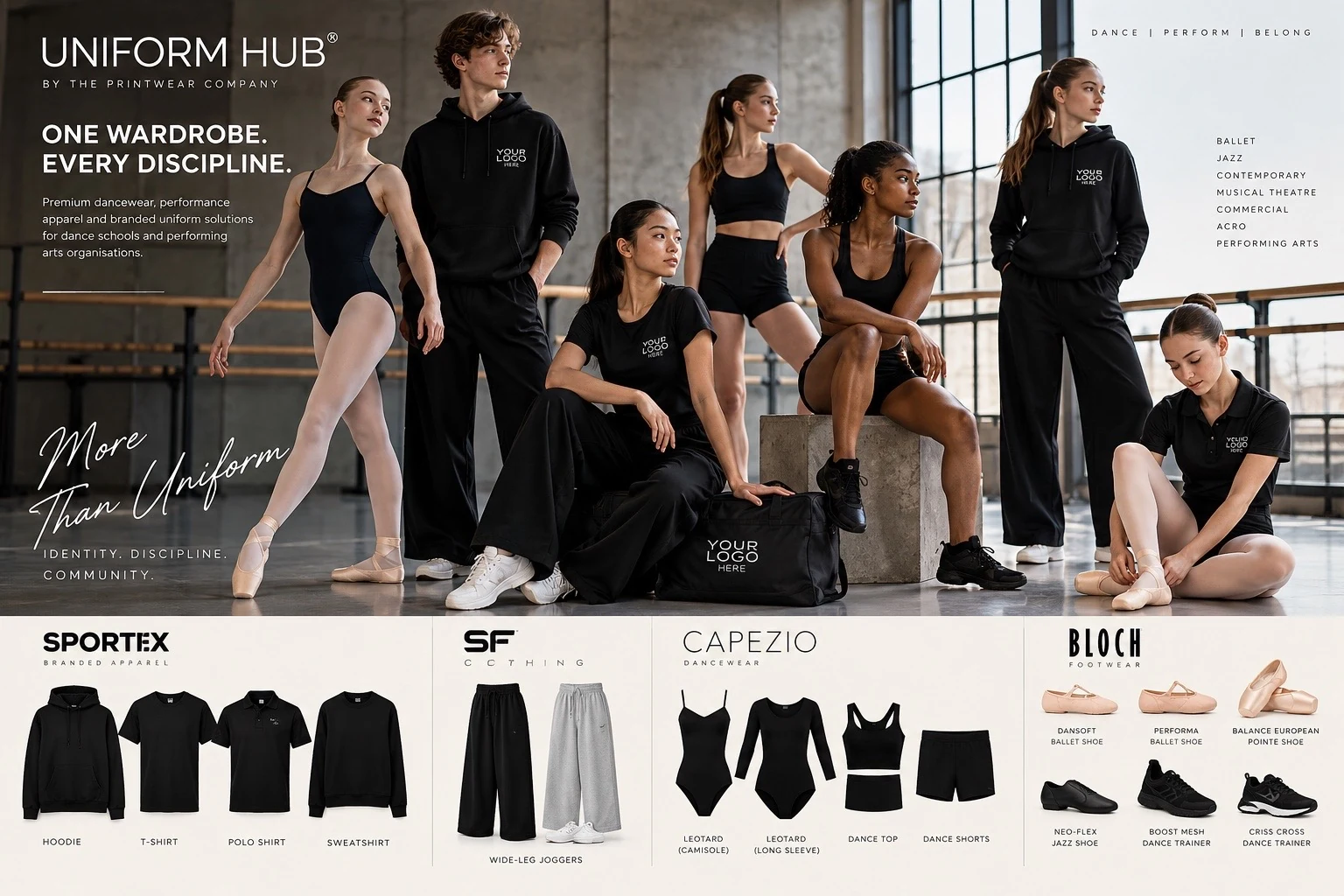
Uniform Hub® is The Printwear Company’s Uniform Management System. It provides approved ranges, ordering structures, scheduled ordering windows, FitKit® sizing support, production and fulfilment for growing dance schools and performing arts organisations.
For more detail, read School Uniform Management System and Inside The Uniform Hub®.
A structured uniform system is designed to address recurring operational problems, including:
The solution is not always more clothing. It is clearer structure around the clothing the organisation already needs.
What is a dance school uniform?
A dance school uniform is approved clothing worn by students, staff or teams for training, teaching, performance or organisational activity. It may include dancewear, warm-up clothing, staff apparel, teamwear and optional merchandise.
What should a dance school uniform include?
A dance school uniform should include only the garments required for the organisation’s programmes and activities. The range may cover student uniform, teacher and staff uniform, teamwear and competition apparel, and supporter merchandise and fanwear.
Should dance schools use mandatory uniforms?
A mandatory uniform can provide a clear standard for specific classes or programmes. It should be based on teaching requirements, comfort, suitability and communication clarity rather than adding products without a defined purpose.
What is the difference between school ordering and parent ordering?
School ordering means the organisation collects requirements, places a consolidated order and manages distribution. Parent ordering allows families to place individual orders through an approved range, usually within defined ordering windows.
How should children be measured for dance school uniform sizing?
Dancewear sizing should follow the size guidance provided for each specific garment, because sizing can vary between garments and manufacturers. Accurate measurements are then used to select the appropriate size rather than relying on general clothing sizes.
How can a dance school make its uniform more consistent?
Define an approved garment range, document logo and decoration standards, separate mandatory and optional items, and use a repeatable ordering and production process. Consistency depends on the system around the garments as well as the garments themselves.
What is event merchandise?
Event merchandise is apparel or related merchandise created for a specific competition, showcase, graduation or other event. It sits alongside the uniform ecosystem and should not be treated as a fifth uniform category.
Effective uniform systems are defined by design, purpose, consistency and repeatable management, not by the number of garments offered. The value sits in how the range is structured, communicated and controlled.
As an organisation grows, uniform requirements become more complex. New programmes, teams, staff roles and events need to be defined, branded, ordered and produced in a controlled way. That is where a managed system becomes operationally valuable.
A suitable uniform approach begins with an assessment of your current structure.
Review:
The Printwear Company can assess your organisation’s current uniform structure, ordering process and growth plans through a Uniform Hub® consultation. The purpose is to define the right approach before production begins.
For identity-led requirements, explore Brandworx®. For event-led requirements, review the Artworx® collections.