


For many dance schools, attracting new students and keeping existing ones has become increasingly difficult.
The instinctive response is often to focus on marketing.
Run another open day. Post more frequently on social media. Promote a free trial. Introduce a referral offer. Spend more on advertising.
All of those things can help.
But recruitment asks a bigger question than how do we get more people through the door?
It also asks what makes a dance school’s branding, identity and sense of belonging strong enough that people want to stay.
What makes this school distinctive?
And retention asks an even more important one:
Why should they want to stay?
Those questions take us beyond marketing and into brand, identity, culture and belonging.
Because a dance school isn’t simply somewhere people go to learn dance.
At its best, it becomes somewhere they feel part of something.
And that changes the conversation completely.
Price matters. Location matters. Timetables, teaching quality, facilities and opportunities matter.
But people also make decisions emotionally.
They look for places that feel right for them.
Parents are assessing whether an organisation feels professional, trustworthy and aligned with what they want for their child. Young dancers are looking at the people, environment and culture and asking a slightly different question:
Can I see myself here?
That judgement begins long before somebody attends their first class.
It happens when they discover your Instagram account.
When they visit your website.
When they see your students at a competition.
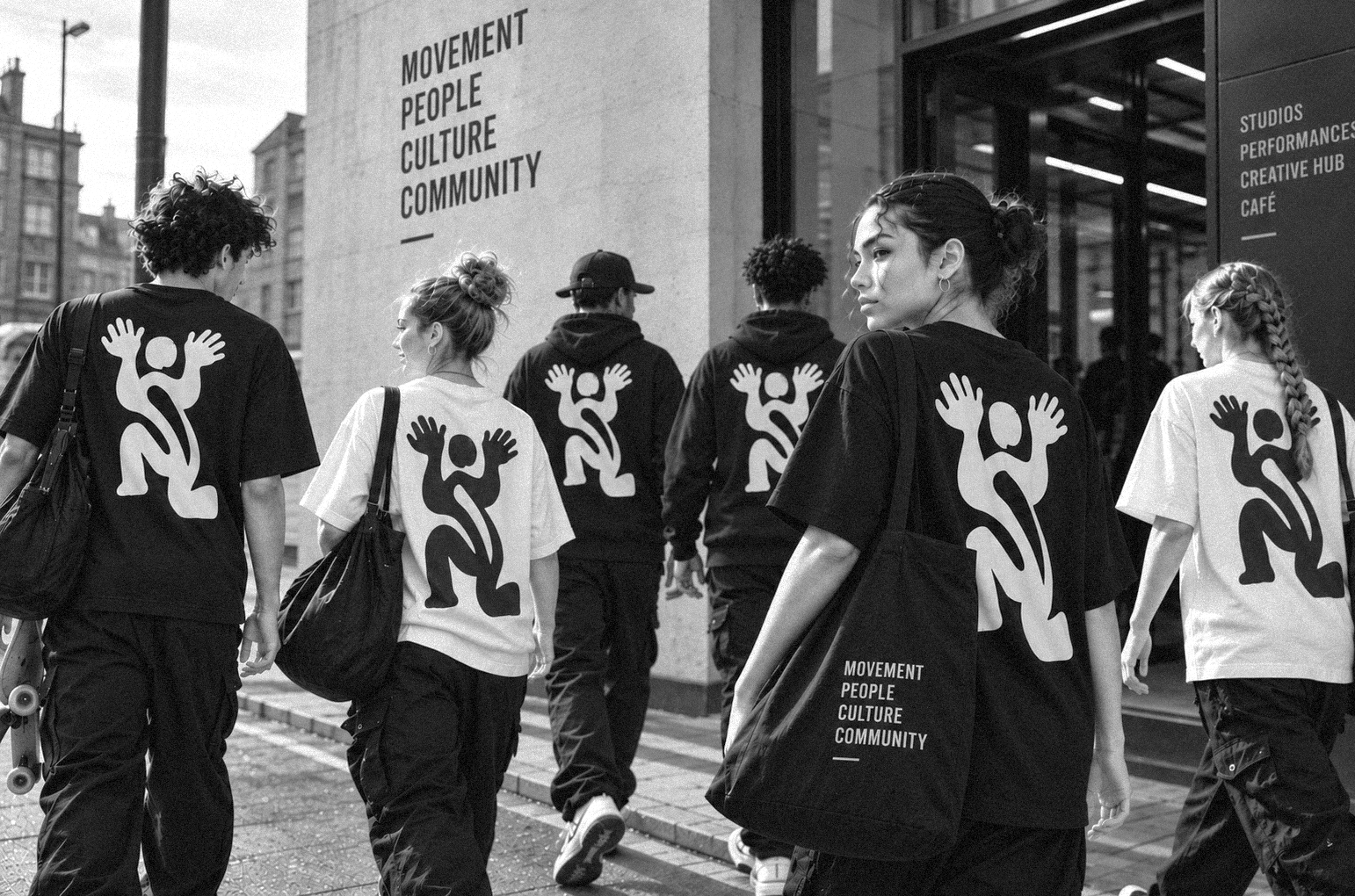
When somebody walks through town wearing your hoodie.
When they encounter your logo.
When they see photographs from your latest production.
Individually, these might seem like small things.
Collectively, they form an impression of who you are.
That is your brand.
A dance school brand is the combination of what a school communicates visually, how it behaves, and what its students and families experience and feel about it, expressed through its logo, environment, apparel, performances and community.
A logo is important. It gives an organisation a recognisable visual identifier.
But a logo and a brand are not the same thing.
Your logo identifies you. Your brand is what people understand, experience and eventually feel about you.
For a dance school, that brand can be expressed through your visual identity, language, teaching environment, apparel, performances, social content, values and the way students represent the organisation outside the studio.
The strongest schools develop consistency between those things.
The visual identity feels like the organisation.
The apparel feels like the organisation.
The photography feels like the organisation.
The performances feel like the organisation.
And, most importantly, the people begin to feel that they are part of the organisation.
That is where identity starts becoming community.
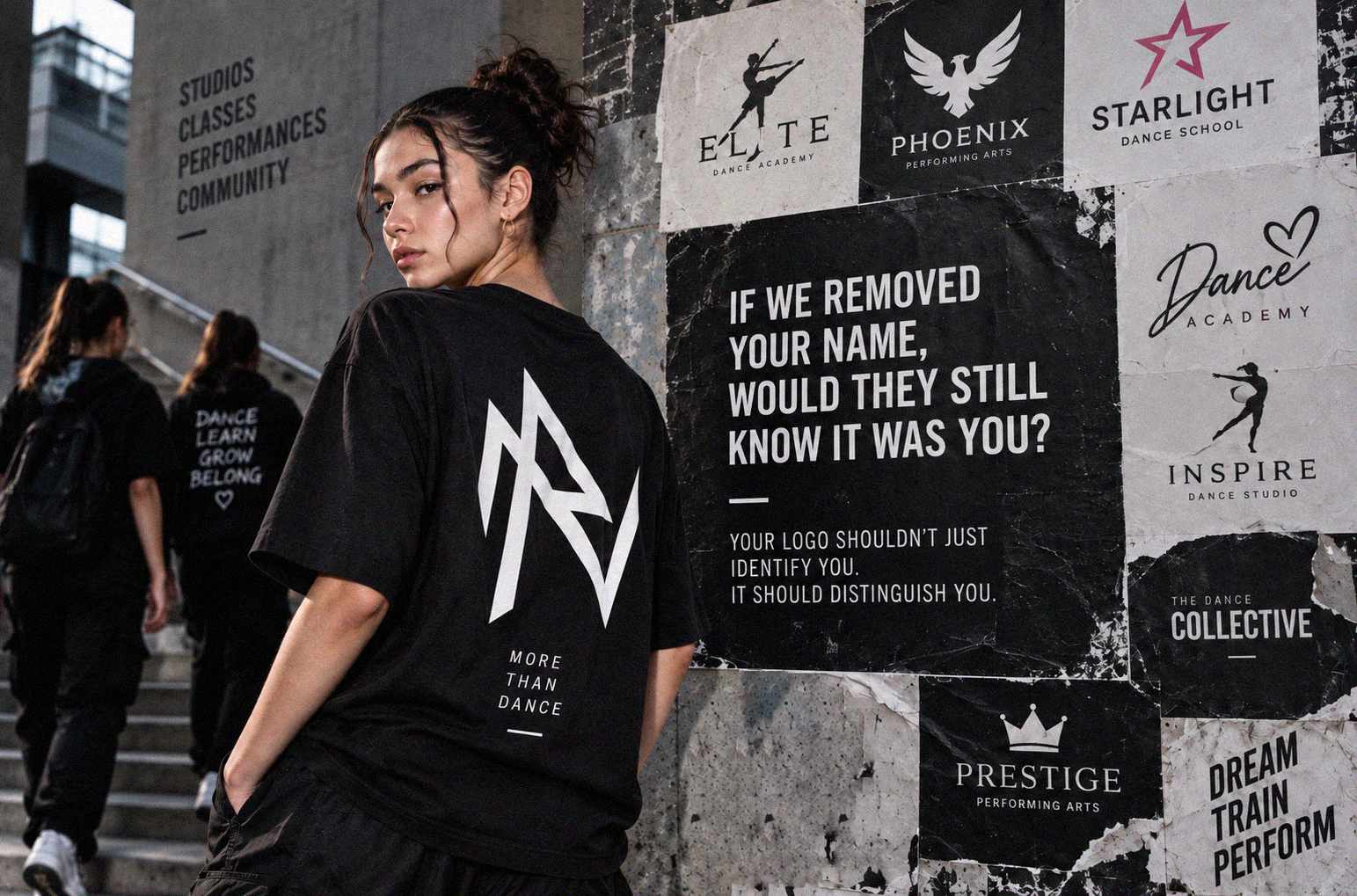
Spend some time looking across the visual landscape of dance and performing arts schools and certain conventions appear repeatedly.
Dancer silhouettes. Leaping figures. Stars. Script lettering. Glitter effects. Similar typography. Similar colour palettes. Similar approaches to uniforms and hoodies.
There is nothing inherently wrong with any of those elements.
The problem begins when visual conventions become so dominant that one organisation becomes difficult to distinguish from another.
This raises a simple question:
If we removed your school’s name from your logo, would people still know it was you?
A strong identity should create recognition, not simply communicate the category you operate in.
Your identity does not just need to say dance.
It needs to say you.
That means understanding what makes the school distinctive before deciding what it should look like.
Its history.
Its teaching philosophy.
Its ambitions.
Its personality.
Its students.
Its community.
Its culture.
The visual identity should be an expression of those things, not a substitute for them.
This matters because dance has always been social as well as technical.
Students train together. Rehearse together. Travel together. Perform together. Compete together. Celebrate together and, occasionally, spectacularly fall apart together five minutes before curtain-up.
Those shared experiences create relationships.
Over time, they create culture.
And culture creates belonging.
For younger dancers especially, the value of participating in dance can extend far beyond learning choreography or developing technique. The studio can become a social environment, a source of friendships, confidence, shared identity and personal development.
For a school trying to improve retention, that distinction matters. Our guide to the costs of fragmented dance school uniform purchasing also explores how inconsistent apparel administration affects the school experience.
Arts Council England’s October 2026 research into private dance schools, undertaken by the University of Bedfordshire, mapped more than 5,200 providers and highlighted financial pressures and barriers to participation. This evidence reinforces the importance of access and affordability alongside identity and belonging. Read the One Dance UK research summary.
A student who simply attends a class has a transactional relationship with the organisation.
A student who believes this is my school, my team, my people has something very different.
A 2024 systematic review by Sango and Pickard synthesised fourteen studies of belonging in adolescent dance. It found that supportive social environments, peer acceptance, empowerment and collaborative relationships can help foster belonging. The authors noted that belonging is rarely the primary focus of dance research and called for more diverse study populations.
You cannot manufacture that feeling with a new logo.
But you can build an organisation that deliberately supports it.
This is where uniforms, teamwear and merchandise become much more interesting than garments with logos printed on them.
Apparel is one of the few brand assets students can physically adopt. For the wider system decisions, including product ranges, sizing and ordering, see our complete guide to dance school uniform systems
A well-designed hoodie can say:
I’m part of this.
Teamwear can create collective identity at competitions.
A graduation garment can mark someone’s history with the organisation.
Show apparel can commemorate a shared experience.
A uniform can create consistency and professionalism inside the studio.
And apparel worn outside the school carries the identity into the wider community.
That does not mean covering every available surface with an enormous logo.
In fact, some of the strongest apparel identities work because they are treated with the same creative consideration as a fashion or cultural brand.
Students should want to wear the clothing, not simply be required to wear it.
The difference is significant.
One is uniform as an obligation.
The other is identity as a choice.
There is another important shift here.
A school’s brand does not belong solely to its owner.
Students carry it.
Parents talk about it.
Teachers embody it.
Alumni remember it.
Competition teams represent it.
Every interaction contributes to what the organisation means to the people around it.
That makes brand building less about controlling an image and more about creating a coherent culture people recognise and want to participate in.
Ask yourself:
That final question may be the most important.
Because the answer tells you whether you have built somewhere people attend or somewhere people belong.
This distinction is important.
A new identity will not compensate for poor teaching, an unhealthy culture, unsuitable timetables, weak communication or a bad student experience.
Branding is not a sticking plaster for operational problems.
But when the underlying experience is good, a strong brand can help make that value visible, recognisable and shareable.
It can help prospective students understand what makes you different.
It can give existing students stronger ways to identify with the organisation.
It can make the school’s culture tangible across its website, social media, environment and apparel.
And it can create consistency between what the organisation says it is and what people actually experience.
That is where branding starts contributing to recruitment and retention.
Not through decoration.
Through identity, differentiation and belonging.
The schools that become culturally strong rarely feel like collections of classes on a timetable.
They develop rituals.
Shared language.
Visual codes.
Stories.
Traditions.
Apparel.
Events.
Memories.
Expectations.
A sense of progression.
A sense of collective identity.
That is community infrastructure.
And when those elements are thoughtfully connected, the organisation becomes easier to recognise, easier to talk about and harder to replace.
So if recruitment and retention are becoming more difficult, perhaps the answer isn’t simply another campaign asking people to join.
Perhaps there is a more fundamental question to ask:
What are you asking them to join?
Because ultimately, people don’t build meaningful relationships with logos.
They build relationships with people, experiences, values and communities.
Your identity gives those things a recognisable face.
Your brand gives them meaning.
Your culture makes them real.
Branding is our field, and our experience points one way: a strong dance school identity is built through consistent decisions and genuine relationships, not a logo in isolation. That is professional experience rather than a research finding, and it is why the distinction matters.
Build a brand people want to belong to.

Related reading: What Does Your Dance School Logo Say About You?
Explore more insights on dance branding, apparel systems, and creative direction.

Start Your Apparel Systems Consultation
Tell us about your organisation, current setup, and apparel requirements. We’ll assess your structure and advise on the right system before any production begins.
The Printwear Company Ltd.
16 David Hobbs Rise | Market Harborough | Leicestershire | LE16 7YE
+44 (0)800 464 7144 | studio@printwearco.com
We use essential cookies to run this website. With your permission, we also use analytics and marketing cookies. You can accept all, reject optional cookies, or choose your preferences.